

Skip to Content Skip to Footer
Wyoming WIC
Wyoming WIC
  • Home
  • Women
    • Women
      Breastfeeding
    • Women
      Healthy Tips for Moms
    • Women
      Postpartum
    • Women
      Pregnant
  • Infants
    • Infants
      Feeding & Nutrition
    • Infants
      Growth & Development
  • Children
    • Children
      Toddlers
    • Children
      2-5 Year Olds
  • Families
    • Families
      Activity and Play
    • Families
      Dads
    • Families
      Food & Family Meals
    • Families
      Immunizations
    • Families
      Safety
  • Live Well Blog
  • Food Shopping Guide
  • Español

Sore Nipples

  • Home
  • Women
  • Breastfeeding
  • Common Challenges & Solutions
  • Sore Nipples

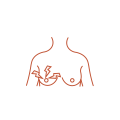
Sore Nipples

When you first start breastfeeding, your nipples may feel tender. Once you and your baby get the hang of it, breastfeeding should not hurt.

Sore nipples may happen:

  • If your baby doesn’t have a good latch
  • If your baby sucks only on the nipple
  • If your baby is pulled from your breast while they’re still sucking
  • If you are pumping with the wrong sized flange

What you can do:

  • Check your nipple after feeding baby
  • - It should look round and long, or the same shape it was before the feeding
  • - If it looks flat or compressed when it comes out of your baby’s mouth, your baby may be sucking on only your nipple

If your baby sucks only on the nipple:

  • 1. Break their suction by putting your finger in the corner of their mouth
  • 2. Let them try latching to your breast again
  • 3. See Getting a Good Latch for more help
  • Ask WIC for help to improve your baby’s latch
  • - They can watch you breastfeed to figure out why you are in pain and help you fix the problem.
  • Try changing positions each time you breastfeed
  • After breastfeeding, express a few drops of milk and gently rub it on your nipples
  • - Human milk has natural healing properties and oils that soothe.
  • Let your nipples air-dry after feeding and wear a soft cotton shirt
  • Avoid tight clothes and bras that put pressure on your nipples
  • Place washable or disposable nursing pads in your bra to absorb leaks
  • -Change nursing pads every 3-4 hours to avoid skin irritation, sore nipples, and infections
  • Do not use harsh soaps, ointments, or astringents on your nipples
  • If your nipples crack, use mild soap and water to clean them
STOPPING OR DELAYING FEEDINGS CAN CAUSE MORE PAIN AND HARM YOUR MILK SUPPLY. TRY TO GET HELP FROM WIC RIGHT AWAY IF YOU FEEL LIKE STOPPING BREASTFEEDING.

Talk to your healthcare provider, WIC, or other breastfeeding expert:

  • If your pain does not go away
  • If your pain comes on suddenly
  • Before using creams, hydrogel pads, or a nipple shield

Sore nipples may lead to a breast infection, which needs treated by a professional.

Wyoming WIC WDH Public Health

CONTACT US

1-888-996-9378
health.wyo.gov/wic
  • How to apply for WIC

Resources

  • WIC Shopper
  • WIC Smart
  • WIC Breastfeeding Support
  • Wyoming Medicaid
  • Wyoming 211
  • Tell a friend about WIC!
  • Guide to Using Your WIC Benefits
  • Wyoming WIC fa fa-facebook
  • Wyoming WIC fa fa-instagram
  • Wyoming WIC

USDA is an equal opportunity provider, employer, and lender.

Cookie PolicyPrivacy Policy

© Brush Art Corporation
This website is operated by Brush Art Corporation on behalf of the Wyoming Department of Health.

Install this web app on your iPhone: tap ios-share and then Add to Home Screen.

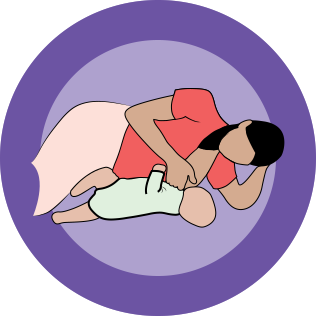
SIDE-LYING HOLD

Side-Lying Hold

  1. For the right breast, lie on your right side with your baby facing you.
  2. Pull your baby close. Your baby’s mouth should be level with your nipple.
  3. In this position, you can cradle your baby’s back with your left arm and support yourself with your right arm and/or pillows.
  4. Keep loose clothing and bedding away from your baby.
  5. Reverse for the left breast.

This hold is useful when:

  • You had a C-section
  • You want to rest while baby feeds
  • You are breastfeeding in the middle of the night
  • You and your baby are comfortable in this position
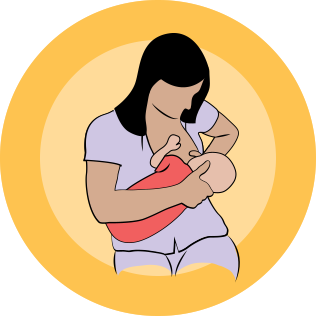
CROSS-CRADLE HOLD

Cross-Cradle Hold

  1. For the right breast, use your left arm to hold your baby’s head at your right breast and baby’s body toward your left side. A pillow across your lap can help support your left arm.
  2. Gently place your left hand behind your baby’s ears and neck, with your thumb and index finger behind each ear and your palm between baby’s shoulder blades. Turn your baby’s body toward yours so your tummies are touching.
  3. Hold your breast as if you are squeezing a sandwich. To protect your back, avoid leaning down to your baby. Instead, bring your baby to you.
  4. As your baby’s mouth opens, push gently with your left palm on baby’s head to help them latch on. Make sure you keep your fingers out of the way.
  5. Reverse for the left breast.

This hold is useful when:

  • Your baby is premature
  • Your baby has a weak suck
  • Your baby needs help to stay latched
  • Your baby needs extra head support
  • You and your baby are comfortable in this position
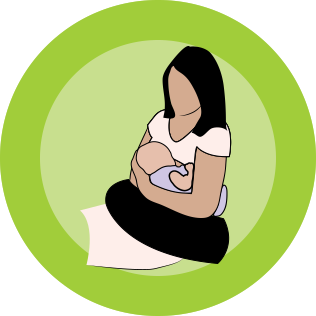
CLUTCH OR “FOOTBALL” HOLD

Clutch or “Football” Hold

  1. For the right breast, hold your baby level, facing up, at your right side.
  2. Put your baby’s head near your right nipple and support their back and legs under your right arm.
  3. Hold the base of your baby’s head with your right palm. A pillow underneath your right arm can help support your baby’s weight.
  4. To protect your back, avoid leaning down to your baby. Bring baby to you instead.
  5. Reverse for the left breast.

This hold is useful when:

  • You had a C-section
  • You have large breasts
  • You have flat or inverted nipples
  • You have a strong milk let-down
  • You are breastfeeding twins
  • Your baby likes to feed in an upright position
  • Your baby has reflux
  • You and your baby are comfortable in this position
CRADLE HOLD

Cradle Hold

  1. For the right breast, cradle your baby with your right arm. Your baby will be on their left side across your lap, facing you at nipple level.
  2. Your baby’s head will rest on your right forearm with your baby’s back along your inner arm and palm.
  3. Turn your baby’s tummy toward your tummy. Your left hand is free to support your breast, if needed. Pillows can help support your arm and elbow.
  4. To protect your back, avoid leaning down to your baby. Instead, bring your baby to you.
  5. Reverse for the left breast.

This hold is useful when:

  • Your baby needs help latching on
  • You and your baby are comfortable in this position
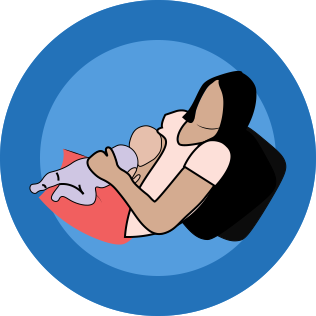
Laid-Back Hold

Laid-Back Hold

  1. Lean back on a pillow with your baby’s tummy touching yours and their head at breast level. Some moms find that sitting up nearly straight works well. Others prefer to lean back and lie almost flat.
  2. You can place your baby’s cheek near your breast, or you may want to use one hand to hold your breast near your baby. It’s up to you and what you think feels best.
  3. Your baby will naturally find your nipple, latch, and begin to suckle.

This hold is useful when:

  • Your baby is placed on your chest right after birth
  • You have a strong milk let-down
  • You have large breasts
  • You and your baby are comfortable in this position